The Force Awakens

Unless you were vacationing on a swamp in Dagobah over Thanksgiving, you probably know that the teaser for “Star Wars: The Force Awakens” landed.

I’ve been a fan of the franchise since early 1997.  That’s right, my first exposure to the galaxy far, far away was the theatrical release of the Special Editions.  (I promptly purchased the original trilogy on VHS, so I have seen it unaltered.)  When I say “first exposure,” I mean I knew nothing about George Lucas’s universe.  I’d seen a picture of Darth Vader somewhere, and having been a fan of Teenage Mutant Ninja Turtles, I assumed he was some sort of futuristic depiction of Shredder.
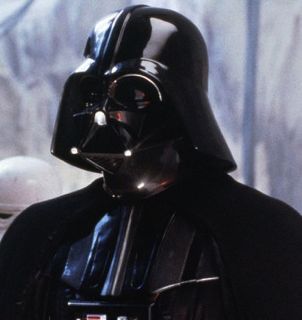
Darth-Vader_smaller Shredder_movie

I remember going to “Star Wars” with a friend, not entirely certain what I was seeing.  Is this a sequel?  A remake?  The effects looked modern, but the haircuts did not.  Like much of my generation…and previous generations…and generations since…I was excited by the expansiveness of the world, the memorable characters and the simple yet resonant themes.

But I’ve got no love for the prequels.  (Controversial, I know.)  I find them dramatically inert, despite material that’s actually pretty compelling.  I’m often drawn to stories about good people going bad.  Paging “The Godfather” and “Breaking Bad.”  The prequels also look very…plastic.  I watched the original “Star Wars” prior to the teaser release, and a couple days later, I watched the duel between Anakin and Obi-Wan in “Revenge of the Sith.”  The attack on the Death Star is still exceptional, with just a couple inserts that don’t hold up.  The duel, on the other hand, is only a few pixels shy of a video game.  Stunning when you consider the nearly 30 year difference, the larger budget for “Sith”, and that the Death Star sequence is more complex.

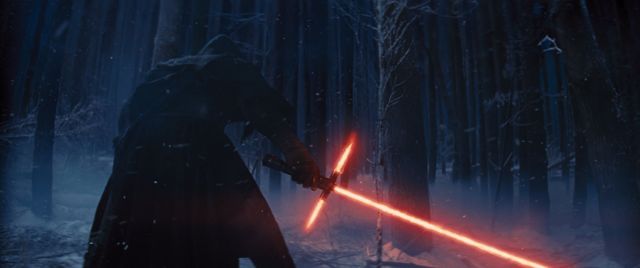
One of the things I appreciate most about the teaser is that it looks to return to the “lived in” science fiction universe that “Star Wars” popularized in the first place.  There are some great tactile details, like the water vapor surrounding the X-Wings as they roar across a lake.  The locations feel real, like the snowy forest featuring what might be the film’s antagonist.

x wings smaller sith-smaller

Admittedly, the teaser is scratching some nostalgic itches.  Stormtroopers?  Check.  Lightsaber?  Check.  Millennium Falcon and John Williams’s fanfare?  Double check!  I don’t imagine it’ll sway anyone who’s altogether disinterested.  Then again, these films are so steeped in our culture, it’s one of a few franchises — maybe the only one? — that probably doesn’t need to worry about educating the masses.

Within the signposts, there are some interesting twists.  I especially like the first image:  an empty desert expanse, then actor John Boyega pops into frame in what seems to be a nod to Sergio Leone’s “The Good, the Bad and the Ugly.”  Dressed in a Stormtrooper outfit, he’s clearly concerned.  Whoa, a Stormtrooper!  Is he our main character?  And how great is it to see a person of color featured prominently in the first trailer for what will likely be the biggest movie of 2015!

boyega smaller

Then there’s the lightsaber hilt (pictured above), which has caused an uproar in parts of the fan community.  C’mon!  Technology in Star Wars has only ever been functional insofar as it looks used.  These films are as soft as science fiction gets — more fantasy, really — and everything is designed toward that aesthetic.

Where’s the practicality in having a cockpit inside a glass bubble that hangs off the side of a spacecraft?
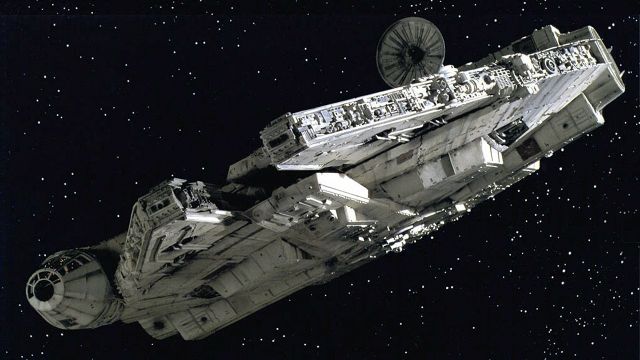
falcon

And what’s logical about invading a snow planet with large walkers that can sink or, ya know, trip?
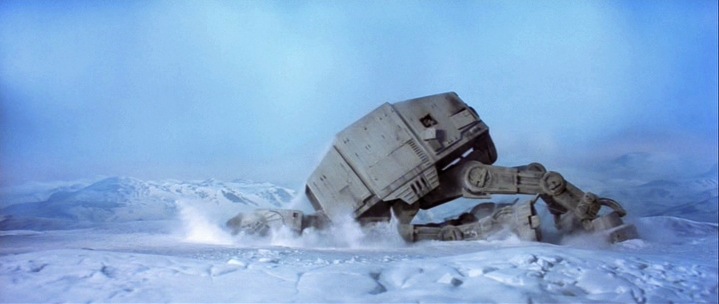
23-imperial-walker-atat-fall-destroyed-falls-battle-of-hoth

Besides, how many hands would a hilted lightsaber save?
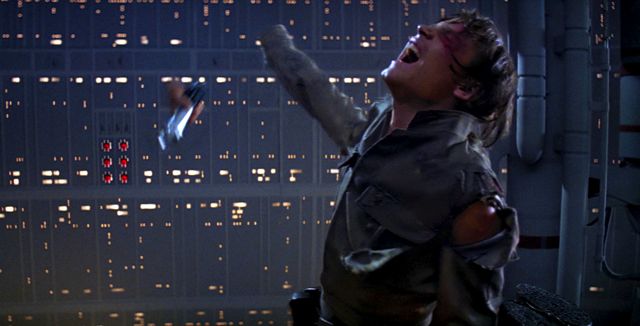
Lukenohand

Finally, there’s the voice-over, delivered by Andy Serkis.  He describes an awakening in the Force, both the Dark Side and the Light.  What the hell happened?  What does it mean for Luke?  Have his powers been dormant?  The desert location featured in the teaser looks like Tatooine.  Did Luke seclude himself there like Obi-Wan?  I also thought it was pretty cool that they didn’t feature Mark Hamill or any of the original cast members.  No doubt they’ll show up in the first full trailer, but for now, the marketing is focused on new characters.

Given the prequels, I was pretty skeptical about another run of Star Wars movies, but Disney and Lucasfilm have gone a long way in reigniting my excitement.  J.J. Abrams is a solid if safe choice to direct Episode VII.  And I’m a big fan of writer-director Rian Johnson (“Brick,” “Looper”), so I’ll be excited to see where he takes Episode VIII and IX.  Of course there’s Gareth Edwards, director of this year’s “Godzilla,” currently working on the first spin-off.  And they’ve assembled a great group of performers for this first film.  I’ve mentioned Boyega, Serkis and the original cast, but there’s also Max Von Sydow, Adam Driver, Oscar Isaacs and Lupita Nyong’o.  With the strength of the teaser and the franchise’s new pedigree, the Force may have indeed awakened.

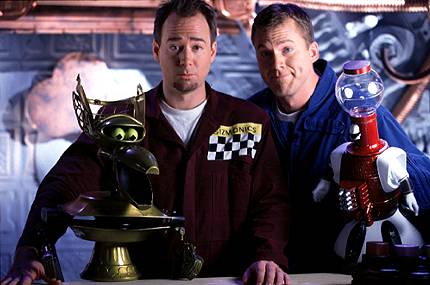
In the not-too-distant future: A Guide to MST3K

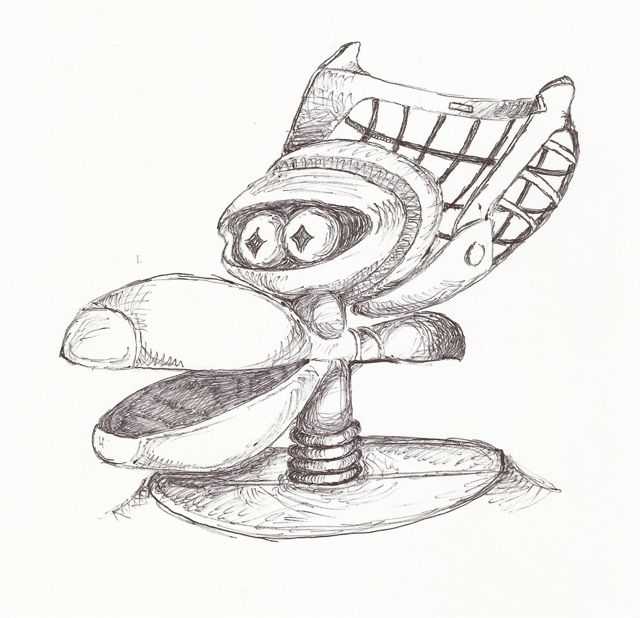
As I’ve written before (and before that), one of my great pleasures is watching “Mystery Science Theater 3000” (MST3K).  Created by Joel Hodgson, it’s a TV series about a man shot into space – initially Joel, then Mike Nelson in later seasons – and forced to endure the worst movies imaginable.  He builds two robots, Crow and Tom, to help him cope.  The three of them spend their time on the Satellite of Love mercilessly making fun of bad films.

Mike and Joel

MST3K aired on Comedy Central for a time, and during Thanksgiving, the network celebrated Turkey Day by running back-to-back episodes.  The last two years, these marathons have streamed on the web.  So what better time to talk about some of my favorites!  I’ve even roped in a couple friends of the blog, Ben DeLoose and Ben Raymond, to share theirs as well.

First, you’ll hear from me.

The Giant Spider Invasion

Season 8, Episode 10

Host: Mike

Giant spider

I joke with my wife that the best MST3K episodes have titles that sound like they belong on the show.  And that’s certainly true of “The Giant Spider Invasion.”  From its title onward, it’s B-movie goofiness (C or D even).  We’ve got a “wisecracking” sheriff who takes calls about strange occurrences and conveniently repeats them for exposition.  A dysfunctional couple living in squalor — “You want a piece of milk?” — who discover coconut-shaped rocks containing spiders from outer space.  Two scientists, who occasionally roll on each other, attempt to unravel the mystery.  There’s giant spider that looks like a prop from a bad high school play.  “A spider the size of a Buick’s attacking his Buick.”  And a riot that ensues after the spider’s appearance, because…why not?  “Packers won the Super Bowl!”

Time Chasers

Season 8, Episode 21

Host: Mike

Time Chasers 3

What I find most endearing about “Time Chasers” is that it’s really striving to be a major Hollywood production.  It’s high concept, telling the story of an inventor who creates a time-traveling airplane and sells it to a corporation with nefarious plans.  There’s adventure and romance, one-liners aplenty.  “You wanna fly?  Let’s fly!”  And it even manages some setup and pay off involving skydiving grandmas.  Mike and the bots spend a lot of time ribbing the low budget and unappealing characters.  We’ve got a Jay Leno-chinned hero who’s a poor man’s Richard Dreyfuss, a marbly mouthed villain, and a love interest with no fashion sense.  “Two different kinds of plaid?!  Man, I’m a naked robot and even I know that’s a no-no.”

The Final Sacrifice

Season 9, Episode 10

Host: Mike

Final Sacrifice copy

Ah, “The Final Sacrifice”…or as I like to call it, “Star Wars in Canada.”  A young man finds a map that belonged to his late father.  He’s pursued by a cult leader clad in black, and he even has a mentor of sorts named Obi Wa–I mean, Rowsdower.  Zap Rowsdower.  Yep.  Wow.  An overwhelming amount of the episode is spent making fun of our ineffectual hero -– “I haven’t read Tolkien in weeks!” — and his hilariously named cohort.  “Rowsdower mobile away!”  I could fill this space with just jokes about the character’s name.  Oh there’s also a fugitive who sounds like Yosemite Sam!

Now let’s hear from Ben DeLoose.

Manos: The Hands of Fate

Season 4, Episode 24

Host: Joel

torgo

If there’s one MST3K episode in the public consciousness, it’s “Manos: Hands of Fate.”  It is the perfect bad movie.  Crummy camerawork, bad dubbing, no discernible plot progression, excess characters, and a nonsense ending — a storm of terribleness.

It’s daunting to write about this one, as so much has already been said, so here’s a new take: “Manos” is not the be-all end-all of MST3K.  There’s not a “before Manos” and “after Manos” in the show’s run.  It’s not the most essential episode.  It’s not the best episode to show a new viewer.

Fanboys love to scream and shout about their shiny toy of an episode, “This is the one, this is the one!”  But they’re usually wrong.  “The X-Files” has “Home,” “Buffy” has “Once More with Feeling,” and “Doctor Who” has “Blink.”  MST3K has “Manos.”

And “Manos” is certainly hilarious.  It’s a top ten episode for sure, but free your mind and consider other gems MST3K has to offer…

Pod People

Season 3, Episode 3

Host: Joel

trumpy

There are no pod people in this movie.  There really aren’t any pods.  And I’d hate to classify the characters in it as people.  I don’t know where to begin with this, much like the film doesn’t seem to know either.  There are three concurrent and uninteresting plots — each highlighted by uninteresting people doing uninteresting things, dubbed by uninterested voice actors.  When the threads collide, it’s not a revelatory narrative experience, but rather an eye-rolling collapse into tedium.

The film follows no-talent musicians on a camping trip, two evil poachers, and a barely-functioning family living in the middle of nowhere — with a newborn alien thrown into the mix.  Joel and the bots try to keep track of what’s going on in Movie A and Movie C, but the real fun is when they (especially Crow) mock the titular pod person/E.T. rip-off, Trumpy.  The long stretches of quiet in the creature’s scenes provide a canvas for the Satellite of Love crew to blurt out anything they can to fill the silence.  And it’s genius.

Soultaker

Season 10, Episode 1

Host: Mike

soultaker

One of the constant fears in television production is extending a show past its shelf life: dramas with recycled plots or comedies with stale humor.  But that was never the case with MST3K.  The writing staff’s riffing and the characters’ rhythm came to a boiling point of excellence in the last two seasons, and thus we have the final season premiere: “Soultaker.”

This might be the funniest episode of MST3K.  Truly.  Other episodes have a higher joke count, but the belly laughs I get from “Soultaker” are immense.

And I think that’s partially because this is not a terribly-made movie.  Many of the films in the MST3K oeuvre are 50’s B-schlock, poorly dubbed Japanese imports, or shoddily made cash-grabs.  But what happens when they tackle a film that could have easily been good?  It forces the comedy to come from a deeper place than “Oh look at the crappy ____ the filmmakers did.”

And finally, Ben Raymond.

Space Mutiny

Season 8, Episode 20

Host: Mike

Space7

Splint Chesthair.  Thick McRunfast.  Punch Rockgroin.  Big McLargehuge.  These, friends, are the many nicknames of Dave Ryder, a squealing bicepted pilot/stool pigeon who quells Calgon’s poorly-planned but chisel-jawed mutiny aboard the Southern Sun spacecraft.  At the behest of the holly-jolly Commander Jansen and his slutty grandma-daughter Lisa, Ryder punches henchmen in the mask, neck, chest, and frequently groin before throwing them off a shaky railing and saving the day.  Shot on-location in an abandoned factory not at all festooned to look like a spaceship, “Space Mutiny” boasts some of the absolute finest intra- and extra-filmic humor in MST3K history.  Some jokes tell themselves, and Mike and the boys take care of the rest.  When it comes to the best episode of Mystery Science Theater 3000, I put my faith in Blast Hardcheese.

Werewolf

Season 9, Episode 4

Host: Mike

werewolf

With the possible exception of William Sylvester (“Riding with Death,” “Devil Doll”), Martin Sheen’s less talented and creepier cousin, Joe Estevez, is the Satellite of Love’s favorite pin-cushion.  Exhibit A: the atrocious and endlessly re-watchable “Werewolf.”  Some Guy digs up a werewolf skeleton in Arizona.  Another Guy punches him in the face.  Some Guy cuts himself on the skeleton and is escorted to the hospital.  While Some Guy begins lycanthropizing, Some Guy and Another Guy’s boss, Boss Guy, enlist a fellow archeologist, Eastern European Titty Bar Girl, to help uncover the secrets of the exhumed werewolf skeleton.  Boss Guy and Eastern European Titty Bar Girl meet Hero Guy, who is writing a book and wants to bang Eastern European Titty Bar Girl, who’s also pursued by Another Guy.  When Hero Guy and Another Guy fight, Hero Guy is transformed into a werewolf, who then, of course, gets Eastern European Titty Bar Girl in the sack, lycanthropizing her as well.  And Joe Estevez.  He’s there, too.

Make sense?  Course not.  Fuck cares!  See it.

The Touch of Satan (1971)

Season 9, Episode 8

Host: Mike

satan

“This is where the fish lives.”

I must call upon the American Film Institute to rethink its list, “100 Years, 100 Movie Quotes.”  With all due respect to “Frankly, my dear, I don’t give a damn,” the single greatest line in the history of cinema came not from the sprawling epic “Gone with the Wind,” but the inane and noxiously ‘70s “The Touch of Satan.”  Jodie Lee Thompson doesn’t care for the “Lee” part of his name and stumbles upon a nice piece of bucolic ass in Melissa Strickland, who turns out to be a 300-year-old witch and caretaker of her decrepit, homicidal child-grandmother, Lucinda.  When Lucinda’s rampage of violence nearly costs Jodie Thompson his life, Melissa must make the fateful decision to save her beloved grandma-sister, or the man she loves and met 36 hours ago.

Spoilers: We never know how the fish came to live there, his name, his goals, why there is only one of him, or why there’s so much palpable sexual tension between him and Melissa.

Big thanks to Ben and Ben for helping me out this week!  Are you fan of “Mystery Science Theater 3000?”  Comment below with your favorite episodes.

Sketchy Sunday: T-rex

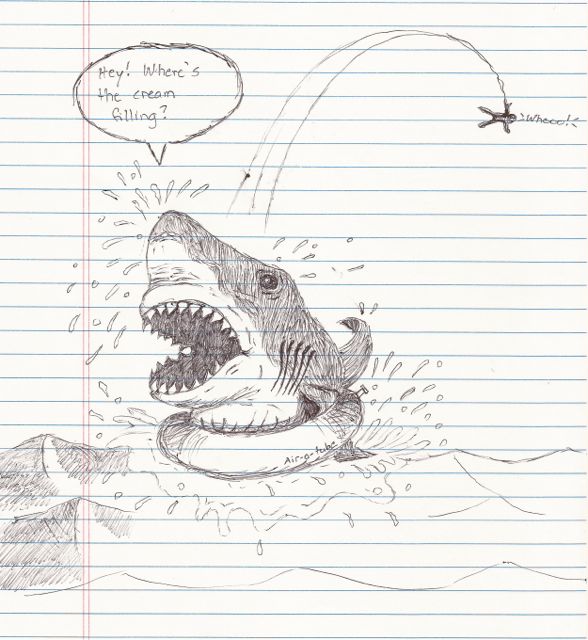
I’m cautiously optimistic for the latest entry in the “Jurassic Park” franchise, “Jurassic World.”  I like Chris Pratt, and Colin Trevorrow is an interesting choice to helm the project.  Yet, “The Lost World” and “Jurassic Park III” did nothing for me, and I can’t help but be suspicious that this is just a cash grab.  Anyway, this morning’s teaser for the teaser got me a little excited, so I whipped this bad boy out…

TRex

Are you excited for “Jurassic World?”  Comment below!

If music be the food of love, write on…or something like that

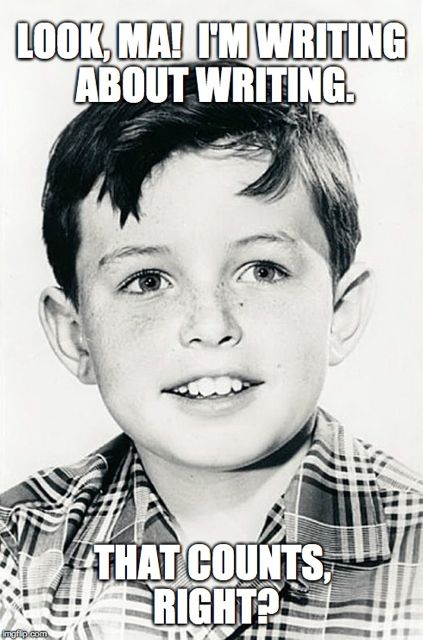
Lately I’ve been struggling with screenwriting, so I thought I’d take a break from that to write about part of my process.  If that doesn’t sound like a fledgling, wannabe writer, I don’t know what does.

Look ma meme

I’ve been working on a feature-length script…and it doesn’t always come easily.  I’m a fan of outlining, but it’s a rabbit hole I tend to tumble down — I just keep outlining, sometimes the same thing, ignoring scenes that are actually giving me trouble.  At the moment, I’m trying what Darren Aronofsky calls the “muscle draft.”  Get it on paper, quick and dirty.  Truth be told, it’s a lot dirtier than it is quick.  (Perhaps I’m neglecting the positives of this approach.)

Anyway, one of the things I’ve found helpful is music.  Not just any music, but a collection of songs curated to the tune of my project.  A few months ago, I finished a coming-of-age script, and I spent a lot of time listening to songs I hadn’t heard since middle and high school. I wanted music that made me feel like I was in that time and place. (Teenage Garrett cringes at the thought.)

But the project I’m working on now is a creature-feature. I’m not gonna delve too much into plot description, but it probably wouldn’t surprise you to know it’s a horror film. Here’s what I’ve been listening to…

1.) “The Passage” from “Alien” soundtrack

2.) “Love” from “Under the Skin” soundtrack

3.) “Above Earth” from “Gravity” soundtrack

4.) “Symphony No. 3: Passacaglia – Allegro Moderato” by Krzystof Penderecki

5.) “The Church” from “28 Days Later” soundtrack

6.) “Down the Pipe” from “The Descent” soundtrack

7.) “Crossing the Crevasse” from “The Descent” soundtrack

8.) “Debris” from “Gravity” soundtrack

9.) “Hyper Sleep” from “Alien” soundtrack

10.) “There Will Be Blood” from “There Will Be Blood” soundtrack

11.) “Car Crash” from “Collateral” soundtrack

12.) “Flight to Compound” from “Zero Dark Thirty” soundtrack

13.) “Agnus Dei” from “Alien 3” soundtrack

14.) “Vincent Hops Train” from “Collateral” soundtrack

15.) “Gravity” from “Gravity” soundtrack

I’ve ordered the mix so that it kind of follows the structure of my script.  (I know the story’s signposts at least.)  “Love” is very sad, designed to evoke my main character.  It’s placed where it is to coincide with her introduction in the script.  “Car Crash” sounds introspective, complementing the lull before the third act.  The marshaling of forces, the calm before the storm.  And “Vincent Hops Train” is heavy on percussion, very action-oriented, representing a climax for both the playlist and the script.

I often listen while I’m writing, but sometimes I take a walk and play it on my iPod.  Generally, I try to avoid music that I’m really familiar with.  There are some scores and films I know a little too well. I can’t be writing a scene, hearing a music cue, and thinking, “Now the shark’s surfaces, Brody jumps back and slowly walks into the cabin.”  That’s why you won’t find any “Jaws” on my mix, even though scary creature-features don’t come any better…obviously.  For a while, a track from “The Social Network” (“Hand Covers Bruise”) had the place of “Love,” but I removed it.  That’s another one I’m just too familiar with.  Wouldn’t want Mark Zuckerberg finding his way into my script.

Screen Shot 2014-11-21 at 7.53.57 PM

What are some of your writing strategies?  How do you get inspiration?  Comment below.

Review: “Interstellar”

The biggest question I had after “Interstellar” was “What happened to the sound mix?”  Hans Zimmer’s score was used to near-deafening effect, which is a shame, because it’s some of his best work in years.  Critical conversations were drowned out by overbearing sound.  And it wasn’t just my theater, other outlets have addressed the issue.  I don’t mean to be glib, but for a film with high-minded ambitions and so much promise in its first two acts, Christopher Nolan’s “Interstellar” left me with nothing but a ringing in my ears.

Warning: this review contains loud noises, black holes and spoilers.

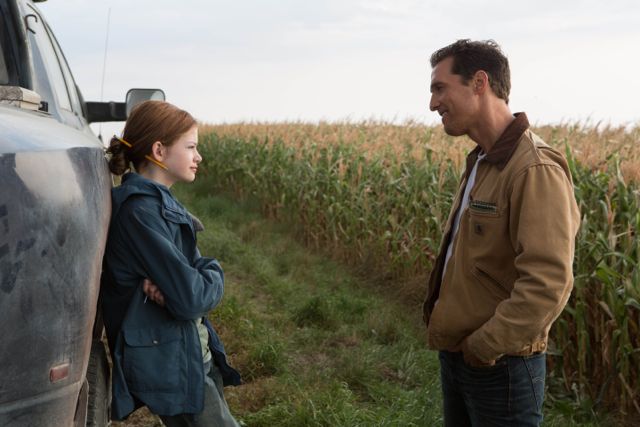
Matthew McCounaughey stars as Cooper, a former NASA pilot raising his son and daughter on a farm.  It’s the future, and Earth is losing the ability to produce food.  The human race is living on borrowed time.  McCounaughey brings an appealing “everyman” quality to the Nolan-universe.   His relationship with his willful daughter, Murph (Mackenzie Foy), consumes the first 35+ minutes of the film, but their development isn’t enough to support a runtime that’s nearly three hours.

INTERSTELLAR

Murph is convinced their house is haunted.  A “ghost” knocks books from a shelf in her room and leaves coordinates in the dust.  Those coordinates take Cooper to a secret NASA facility, where he discovers that Professor Brand (Michael Caine) and his daughter, Amelia (Anne Hathaway), have been working on a plan…or two…to save mankind.  Plan A: travel through a wormhole, investigate three potentially hospitable planets, and use a space station to transport Earth’s population.  Should resources run out before the mission can be completed, Plan B: populate one of three said planets with test tube babies.  Cooper accepts Brand’s offer to pilot the mission, which causes a rift between he and his daughter. “Don’t make me leave like this,” he pleads.

In space, we’re treated to some gorgeous cosmic vistas.  Cooper and his team visit a water planet where time passes more slowly.  Discovering it isn’t suitable, they return to their ship to find that 20 years has passed.  In the film’s most stirring moment, Cooper watches his son grow up over a series of transmissions.  The string of videos ends with his estranged daughter, now as old as he is (played by Jessica Chastain, very strong in the role).  In a great match cut, we watch Cooper’s monitor as Murph turns off her display and then we’re back on Earth with her.  She’s been working with Professor Brand on a way to get the human race off the planet, but on his deathbed, the professor reveals that he’s known for some time that their efforts are wasted.  He sent her father on his mission knowing Earth was doomed.

cosmic vista

The movie hits turbulence with the introduction of Matt Damon.  He plays Mann, an astronaut who was sent to survey one of the potential planets.  I was pleasantly surprised to see Damon at first — the marketing campaign kept him a secret and he’s a great actor — but his role is sorely lacking.  It’s the stock character that’s gone crazy, undone by the enormity of events.  (Reminded me of Tim Robbins in “The War of the Worlds,” a movie that also goes off the rails with his late introduction.) Though the filmmakers get some mileage out of subverting Damon’s upstanding persona, I couldn’t help but wonder: Why this actor for this nothing role?

Learning of the crew’s intentions to follow through with Plan A, Mann sabotages their mission.  He flees to the main craft that’s circling the planet.  In an unsuccessful docking attempt, Mann dies in an explosion that sends the larger vessel spiraling out of control.  Then Cooper successfully manages a docking maneuver in a moment that should be a nail-biter.  Zimmer’s score is insistent on it.  It’s like watching a sporting event and someone’s sitting next to you banging pots and pans together shouting, “Isn’t this exciting?!”  No, not anymore. The whole sequence is cross-cut with Murph trying to get back to her childhood home.  There was something about that ghost.  She runs up against her brother (a misused Casey Affleck), who’s inexplicably turned into a raging asshole.  He’s unconcerned with his family’s deteriorating health, and he’s determined to keep his sister out of the house.  Rather than create tension, we’re wondering why the brother behaves this way at all.  The answer: the plot needs him to.  You can practically hear the film groan — there’s that sound mix again — as it strains to up the ante.

Cooper and Amelia are the only remaining crew members.  While sling-shoting around a blackhole, he ejects into it, which enables Amelia to reach the final planet.  Cooper finds himself in a fifth dimension — no, not the Twilight Zone — where he’s able to view his daughter’s bedroom seemingly at any point in time.  During this sequence, we come to realize that he was her ghost.  This is clearly intended to be a big reveal, but Nolan doesn’t lay the necessary groundwork.  Murph first mentions the ghost early in the film when we’re not yet attached to these characters or invested in this world. The odd story development stands out like a sore thumb – Ghost? Isn’t this a space travel film? It’s like Nolan is a magician, and he forgets to draw our eye away from his trick.  Within minutes of young Murph declaring their house was haunted, I saw where the film was going.

Beyond that, Nolan and his co-writer/brother, Jonathan, have a serious problem with exposition.  Some of their writing passes about as well as a kidney stone.  They’ll make a point…clarify it…and then reiterate it again.  Think about the engineer at the end of “Batman Begins,” practically narrating what will happen if the microwave emitter reaches the center of Gotham.  Or the ferry passengers in “The Dark Knight.”  In both cases, the situations scarcely need explaining, and yet we suffer through these repetitions that sap the scenes of tension.  “Interstellar” is no different.  Lazarus, a Biblical story of a man brought back to life, is a recurring motif.  Waking from hibernation, Mann tells our characters:  “You have literally raised me from the dead.”  With just enough time to say to myself, “Wow, subtle,” Cooper responds, “Lazarus.”

exposition

Nolan’s propensity for over-explanation rears its head in the final climactic sequence.  Cooper tells us that the beings who made the fifth dimension are future humans, and it was created so that he could give his daughter the missing component to Brand’s work.  The wall-to-wall exposition is such an odd, demystifying choice.  So much of the best science fiction eschews explanation for its central conceit.  Why can’t women get pregnant in “Children of Men?”  Who knows.  How exactly are they erasing Jim Carrey’s memories in “Eternal Sunshine of the Spotless Mind?”  Who cares!  When you confine this type of film to a box, you risk — even promise — disillusionment and disappointment.  Nolan is clearly an ambitious filmmaker, but audacity is a big part of ambition.  No matter how noble your intentions or grand your vision, when you package your film in easily digestible bites, you undercut boldness and daring.

All the ambition in the world doesn’t mean much when the experience is this empty.  Loud, but empty.

What did you think of “Interstellar?”  Comment below! 

Review: “Godzilla” (a.k.a. “Gojira”)

This week marks the 60th anniversary of the release of the original “Godzilla,” known as “Gojira” in its native Japan.  The Japanese cut of the film wasn’t available in the States until 2004, so for roughly 50 years, Americans had to make do with the U.S. edit, “Godzilla, King of the Monsters.”  It featured Raymond Burr, thanks to some…unique editing.  The biggest crime of the U.S. version wasn’t Burr’s haphazard inclusion, but the way it muted — eradicated even — the cautionary aspects of the original.

Warning: giant monsters and spoilers ahead!

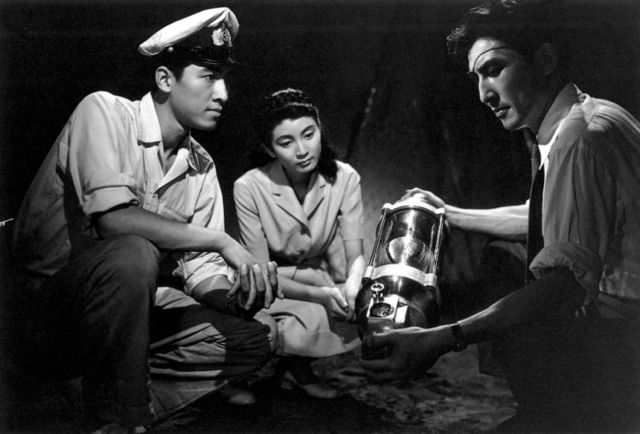
Director Ishiro Honda’s film begins with a dramatization of an event that would have been fresh in the minds of Japanese citizens.  In early 1954, the S.S. Lucky Dragon 5 and the men on board were exposed to fallout from H-bomb testing.  “Godzilla” begins similarly, a group of fishermen are consumed by flames after witnessing a blinding flash of light.  Honda invites our curiosity by completely concealing the monster.  Staging the scene so obliquely, he positions the film as a haunting and even cathartic nuclear allegory.

As more ships disappear, the Japanese public demands answers.  In one of my favorite effects shots – “favorite” not to be confused with “best” — what’s clearly a model boat bursts into flames.  It floats along the surface of the water, a ghost ship, before sinking beneath the waves.  When the full nature of these disasters becomes clear, we get varying perspectives on how to deal with the problem.  Salvage ship captain Hideto Ogata (Akira Takarada) wants Godzilla destroyed.  It poses too great a threat.  Paleontologist Kyohei Yamane (played by Kurosawa-regular Takashi Shimura) wants to preserve the creature for study.  What is it?  How long has it been there?  How did it survive the atomic tests?  They’re linked by Emiko (Momoko Kochi), Kyohei’s daughter and Hideto’s lover.

Among the franchise’s 30 entries, this first film boasts the most compelling human drama.  Emiko’s allegiances are torn between her father, Hideto, and Dr. Daisuke Serizawa (Akihiko Hirata), who she’d been sworn to marry despite her true affections.  Frankly, some of the romantic melodrama could go, but the human element is juiciest when it centers around Serizawa.  Unintentionally, he’s developed a weapon of mass destruction: the Oxygen Destroyer.  When guns, tanks and planes prove ineffective against Godzilla, Emiko and Hideto urge the doctor to use his device.  Only nine years after the bombings of Hiroshima and Nagasaki, he’s reluctant.  “I can’t add another terrifying weapon to humanity’s arsenal.”

Gojira_1954_-_3

The film’s special effects centerpiece is Godzilla’s attack on Tokyo, made possible by “suitmation.”  Pioneered by Eiji Tsuburaya, an actor in a monster suit storms through a miniature city.  Though the technique is dated, many shots hold up.  Honda and Tsuburaya frame Godzilla from low angles with foreground elements — buildings, power lines, and a bird aviary in one case.  This creates scale while inky cinematography hides the seams and contributes to a sense of dread.

powerline-destruction

But, in the infancy of suitmation, there are plenty of geographical inconsistencies.  Firefighters barrel through the streets only to careen off them…presumably due to Godzilla, but we never have a sense of their proximity to each other.  Still, those mishaps are easily overlooked when you consider the number of chilling moments.  A mother comforts her children as the city falls around them.  “Don’t worry, we’ll be with Daddy soon.”

So many films, post-9/11, attempt to channel the apocalyptic sense of doom from that day, but few achieve what this one does.  The morning after the attack, an eerily-calm establishing shot of Tokyo shows the city in ruins.  A young girl cries as her deceased mother is carried through a hospital corridor that’s bursting with wounded citizens.  A doctor examines a patient with a Geiger counter.  A children’s choir sings for peace.  These moments carry all the weight and immediacy of a documentary.  Despite this film having only one city-leveler — not the smorgasbord* of later installments — the stakes have never felt higher.

this-is-tokyo

The sorrowful tone is carried through to the film’s final moments.  Dr. Serizawa, seeing the aftermath of destruction, concedes to use his weapon.  In doing so, he takes his own life.  Now that the world knows of his invention, he can’t be coerced into making another.  Where many films might strike a triumphant note with the demise of the monster, this one does not.  Akira Ifukube’s mournful score recalls the choir’s prayer earlier in the film.  Like many great movie monsters, Godzilla is a victim of man’s overreach.  As Kyohei watches, the ancient creature lets out a death cry and finally succumbs.  He warns — in a bit of dialog that’s just a shade too on-the-nose — against further atomic tests.  Alongside science fiction classics like “Frankenstein” and modern classics like “Blade Runner,” “Godzilla” stands as a stirring reminder of the reckoning that follows from man’s hubris.

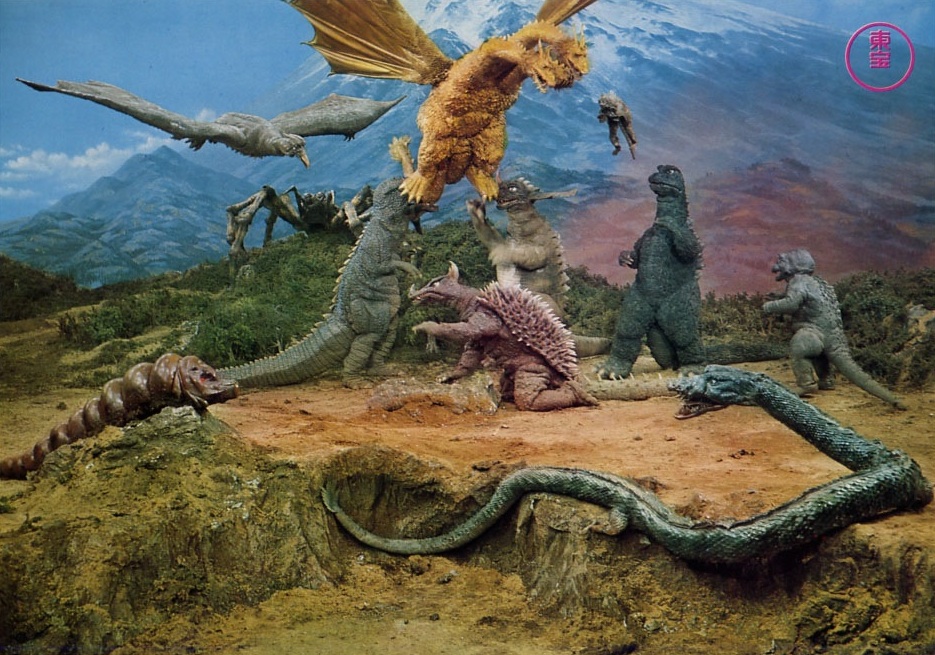
* – Not that I’m casting judgments.  I’m all for a smorgasbord of giant monsters!

DAM

Have you seen the Japanese cut of the original “Godzilla?”  How about the American cut?  Comment below!